Build a killer CV
An academic CV is a comprehensive document that highlights your academic achievements and research experience, whereas a professional CV is a concise summary of your relevant work experience and skills tailored to a specific position. In both cases, your goal is to make your CV stand out to recruiters.
On this page, we give you specific information and examples of both the academic and the professional CV. Besides, we cover general tips that apply to both types of CVs. Wherever your next career step takes you, we’re here to help you move forward.
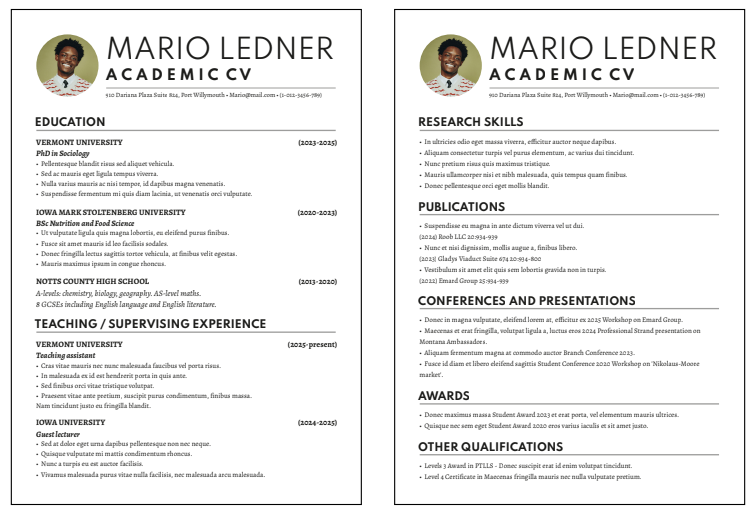
Academic CV
When applying for an academic or research position in the Netherlands, you need to include an academic CV. This is a comprehensive document detailing your educational background, research accomplishments, teaching experience, and other academic qualifications.
Unlike a resume, it's a longer, more detailed overview of your academic career, including publications, presentations, awards, and professional affiliations.
Evidence-based CV
The Dutch Research Council (NWO) offers several calls for proposals, in different schemes and programmes, and they are competition-based. When applying for a call, especially the ones that are part of the NWO Talent Programme (Veni, Vidi, Vici), one of the mandatory documents you need to include is the evidence-based CV. This way, the Council is able to move away from a traditional focus on solely publications and research output, aiming to recognise a wider range of contributions and talents within the academic community. This approach acknowledges that different career paths require diverse skill sets and experiences, and the narrative format allows researchers to showcase their individual strengths and contributions beyond quantity.
- Evidence-based (narrative) CV (.docx)
- Evidence-based (narrative) CV (.pdf without explanatory notes)
For more information about the talent programmes and the evidence-based CV, visit these websites of the Dutch Research Council:
Your professional CV
When applying for a (research) position in other sectors than academia, you need to include a professional or industry resume. The focus of this document should be on job-specific skills and relevant experience for a specific job or career path. It is typically limited to one or two pages and should include contact information, a concise summary or objective statement (e.g. a personal pitch), work experience, education and certifications, skills relevant to the job and optional elements like extracurricular activities and volunteer experience.
How to make your CV stand out to recruiters
Recruiters and HR professionals review dozens, sometimes hundreds of applications daily. At large or popular employers, this often happens in seconds: a CV may be rejected or selected at a glance.
In many organizations, the initial screening is automated via applicant tracking systems (ATS), often supported by AI. A well-structured CV, both in content and format, is crucial to pass this first filter.
Here are 5 essential tips to increase your chances of getting an interview:
- Tailor your CV to the position
- Make an immediate impact
- Lead with what matters
- Use the right keywords
- Keep it clear and concise
Let’s dive into all 5 elements.

Customize your CV for each vacancy, sector, and organization. Use base versions where your achievements, skills, and KPIs are clearly aligned with specific roles or industries. Select the most relevant elements for each application.
Make an immediate impact
In general, in the Netherlands, modern CV standards emphasize privacy and equal opportunities. Applicants are no longer expected to include personal details that are irrelevant to job performance or that could lead to unintended bias. This means, that you do not have to list your date of birth, gender, marital status, number of children, nationality (unless legally required), religion, ethnicity, home address, health information, or political views.
Photos and social media profiles are optional but generally discouraged unless professionally relevant. By omitting these details, candidates help ensure that the recruitment process focuses solely on skills, experience, and suitability for the role.
At AcademicTransfer we do not ask you for a CV that includes these personal details. However, other organisations might still ask for various reasons. Please adjust your CV when necessary.

The top section of your first page is key. Include your name, contact details, and LinkedIn profile. If appropriate, add a professional photo. Start with a concise summary of your most relevant, role-specific accomplishments.
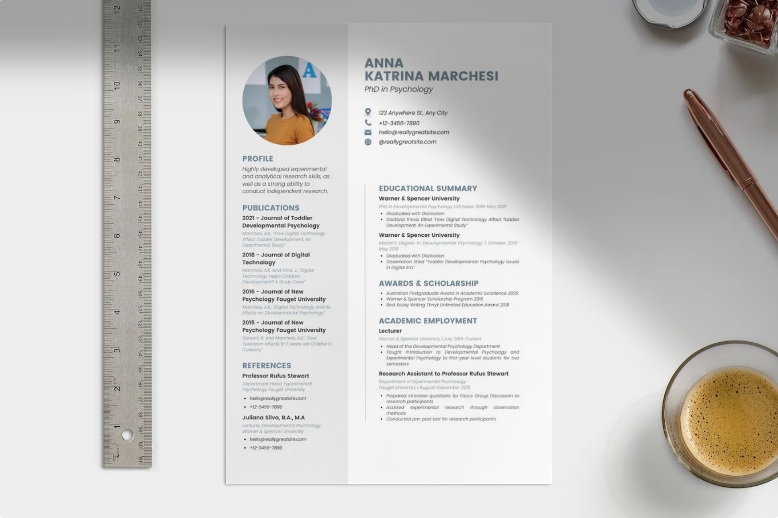
Use a clean layout with enough white space, clear headings, and bullet points. Limit your font choices and avoid excessive styling. Ideally, keep your CV to 2 pages. Any additions on a third page should offer immediate, tangible value.
A short, readable CV also demonstrates your ability to communicate clearly and professionally, a vital soft skill in any workplace.
In summary
An effective CV is results-oriented and convinces the reader that your experience delivers more than it costs. Prove this with measurable achievements, clear examples, and a strong structure that instantly shows why you’re the right choice.